
Montessori vs Traditional Preschool – Which Approach Is Right for Your Child in Navi Mumbai?
Home / School / Montessori vs Traditional Preschool – Which Approach Is Right for Your Child in Navi Mumbai?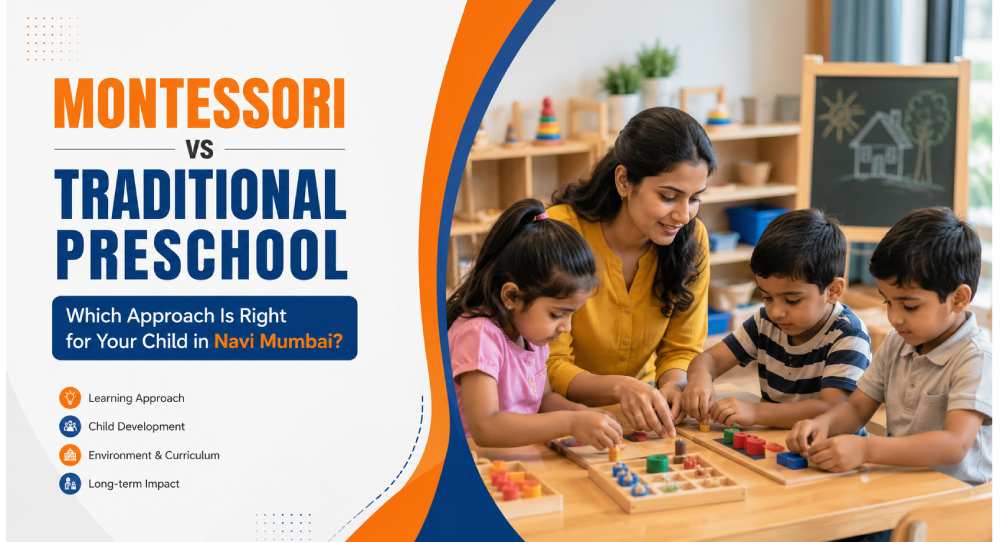
Choosing a preschool is one of the first major decisions parents make for their child. One question that often comes up is whether a child should attend a Montessori school or a traditional preschool.
Parents in Navi Mumbai often compare teaching methods, classroom environments, learning styles, and long-term benefits before making a decision. Both systems have their strengths, but the right choice depends on the child’s personality, learning pace, and family expectations.
For parents searching for a montessori preschool in Navi Mumbai, it helps to understand how Montessori education differs from traditional preschool education. This guide explains both approaches in simple terms and helps parents make an informed choice.
Montessori vs Traditional Preschool
| Factor | Montessori Preschool | Traditional Preschool |
| Learning Style | Child-led | Teacher-led |
| Classroom Setup | Mixed-age groups | Same-age groups |
| Teaching Method | Self-paced learning | Structured lessons |
| Role of Teacher | Guide and observer | Instructor |
| Learning Materials | Special Montessori tools | Books, worksheets, toys |
| Assessment | Observation-based | Activity and performance-based |
For children who enjoy independence and learning through exploration, a montessori preschool in Navi Mumbai may be a suitable option. Children who prefer routine, direct guidance, and structured classroom activities may feel comfortable in a traditional preschool setting.
What Is Montessori Education?
Montessori education was developed by Dr Maria Montessori, an Italian physician and educator, in the early 1900s.
The approach encourages children to learn through exploration, observation, and practical activities. Instead of teachers giving constant instructions, children choose activities from prepared learning materials.
Key Features of Montessori Education
- Child-centred learning
- Mixed-age classrooms
- Practical life activities
- Self-paced progress
- Focus on independence
- Learning through observation and experience
Many parents looking for a montessori preschool in Navi Mumbai prefer this method because it allows children to develop confidence and decision-making skills from an early age.
What Is a Traditional Preschool?
Traditional preschool follows a structured classroom model. Teachers guide students through planned lessons, group activities, storytelling sessions, and classroom exercises.
Children generally learn according to a fixed timetable and curriculum.
Key Features of Traditional Preschool
- Teacher-led instruction
- Fixed classroom schedule
- Age-wise grouping
- Group learning activities
- Regular assessments
- Classroom discipline and routine
Many of the top nursery schools in Mumbai follow this approach because it prepares children for formal schooling from an early stage.
Montessori vs Traditional Preschool: A Detailed Comparison
1. Teaching Method
| Aspect | Montessori | Traditional |
| Learning Approach | Self-directed | Teacher-directed |
| Pace of Learning | Individual pace | Same pace for all students |
| Classroom Activities | Choice-based | Planned by teacher |
| Participation | Independent | Group-based |
In Montessori classrooms, children often choose what they want to work on. Traditional classrooms follow teacher-designed schedules.
2. Classroom Environment
| Montessori Classroom | Traditional Classroom |
| Open learning spaces | Structured seating |
| Child-sized furniture | Standard classroom setup |
| Learning stations | Fixed activity areas |
| Freedom of movement | Limited movement during lessons |
The environment plays an important role in activity learning, especially during the early years.
3. Development of Independence
| Skill Area | Montessori | Traditional |
| Self-care Skills | High emphasis | Moderate emphasis |
| Decision Making | Encouraged daily | Guided by teachers |
| Problem Solving | Independent practice | Teacher assistance |
| Responsibility | Strong focus | Shared responsibility |
Parents often appreciate how a montessori preschool in Navi Mumbai encourages children to manage small tasks independently.
4. Social Development
| Social Factor | Montessori | Traditional |
| Peer Interaction | Mixed-age groups | Same-age groups |
| Leadership Opportunities | Frequent | Limited |
| Team Activities | Moderate | High |
| Collaboration | Natural mentoring | Structured group work |
Both systems support social development, but they do so in different ways.
5. Preparation for Formal Schooling
| Area | Montessori | Traditional |
| Routine Following | Moderate | Strong |
| Academic Structure | Flexible | Structured |
| Classroom Discipline | Self-discipline | Teacher-guided discipline |
| School Readiness | Good | Good |
The situation has changed considerably over the last few years. Modern Montessori schools now include strong school-readiness programmes alongside child-centred learning.
Why Activity Learning Matters in Preschool
Children between the ages of 2 and 6 learn best through experience. This is where things become interesting.
Research shows that children remember concepts better when they physically participate in activities rather than simply listening to instructions.
Benefits of Activity Learning
| Benefit | Impact on Child |
| Better memory | Improves concept retention |
| Improved communication | Encourages language development |
| Greater confidence | Builds self-esteem |
| Strong motor skills | Supports physical development |
| Increased curiosity | Encourages exploration |
This is one reason why many parents consider a montessori preschool in Navi Mumbai when searching for quality early childhood education.
How Nursery Education Shapes Future Learning
Good nursery education lays the foundation for literacy, numeracy, communication, and social skills.
Studies show that children who attend quality preschool programmes often perform better in primary school compared to those who miss structured early education.
Preschool Benefits at a Glance
| Development Area | Benefit |
| Language Skills | Better vocabulary |
| Social Skills | Improved cooperation |
| Cognitive Skills | Stronger problem-solving |
| Emotional Growth | Better confidence |
| Physical Development | Improved coordination |
What Should Parents Look for in a Preschool in Navi Mumbai?
Before finalising admission, parents may consider the following:
Teacher Qualifications
Qualified teachers can understand children’s developmental needs.
Safety Standards
Secure campuses, CCTV monitoring, and child-friendly infrastructure are important.
Learning Environment
Children learn better in welcoming and engaging classrooms.
Parent Communication
Regular updates help parents stay involved.
Balanced Curriculum
A good preschool should combine academics, play, creativity, and physical activities.
Why Many Parents Consider MNR Golden Kids
MNR Golden Kids focuses on creating a positive learning environment where young learners can develop confidence, communication skills, and curiosity.
The school encourages activity learning, early literacy, creativity, and social interaction through age-appropriate programmes. Parents looking for a montessori preschool in Navi Mumbai often compare different preschool models before choosing a school that suits their child’s needs and learning style.
Conclusion
Choosing between Montessori and traditional preschool is not about finding a universally better system. It is about finding the right environment for a child.
A child who enjoys exploring independently may thrive in a montessori preschool in Navi Mumbai. A child who prefers structure and direct guidance may be comfortable in a traditional classroom. For many families, visiting schools, interacting with teachers, and observing classroom activities provide the clearest answers.
Parents searching among the top nursery schools in Mumbai should focus on the quality of teaching, safety standards, learning environment, and overall child development rather than following trends alone.
The right preschool creates happy learners, confident communicators, and curious young minds. Whether parents choose a traditional preschool or a montessori preschool in Navi Mumbai, the goal remains the same: giving children a strong and joyful start to their educational journey.
Frequently Asked Questions
Both systems have benefits. Montessori focuses on independent learning, while traditional preschool follows structured teaching methods.
Most children begin preschool between 2 and 4 years of age.
Yes. Montessori classrooms encourage children to make choices, complete tasks independently, and take responsibility for daily activities.
Yes. Parents can find several options for a montessori preschool in Navi Mumbai depending on their preferred location and curriculum.
Both approaches can prepare children well. The choice depends on the child's personality and learning preferences.
Nursery education helps children build social, language, emotional, and cognitive skills before entering primary school.
Related Blogs
Importance Of Pre-Primary Education In India
There is a moment many parents quietly notice but rarely talk about. A child who…
How Group Activities at the International-Standard Preschool in Panvel Help Nursery Kids Learn Teamwork Early
Walk into a lively nursery classroom at one of the best international-standard preschool in Panvel,…
Working Parents in Hyderabad: How to Choose the Right Play School
Morning hours in Hyderabad move quickly. Office calls begin early, traffic builds up, and between…
How The Best Pre-nursery School in Koproli Helps Children Build Confidence from Day One
The first morning at one of the best pre-nursery school in Koproli is a small…

The Food, The Feelings, The Future: A Simple Guide to Health & Nutrition for Kids!
There is something deeply moving about watching a child eat with joy. The messy fingers….
Why Outdoor Play Is Important for Every Child’s Healthy Growth
Childhood has its own rhythm. It is filled with running feet, curious eyes, and endless…
Leave a comment