
Preschool vs Daycare in Nizampet: What Is the Difference and What Does Your Child Really Need?
Home / School / Preschool vs Daycare in Nizampet: What Is the Difference and What Does Your Child Really Need?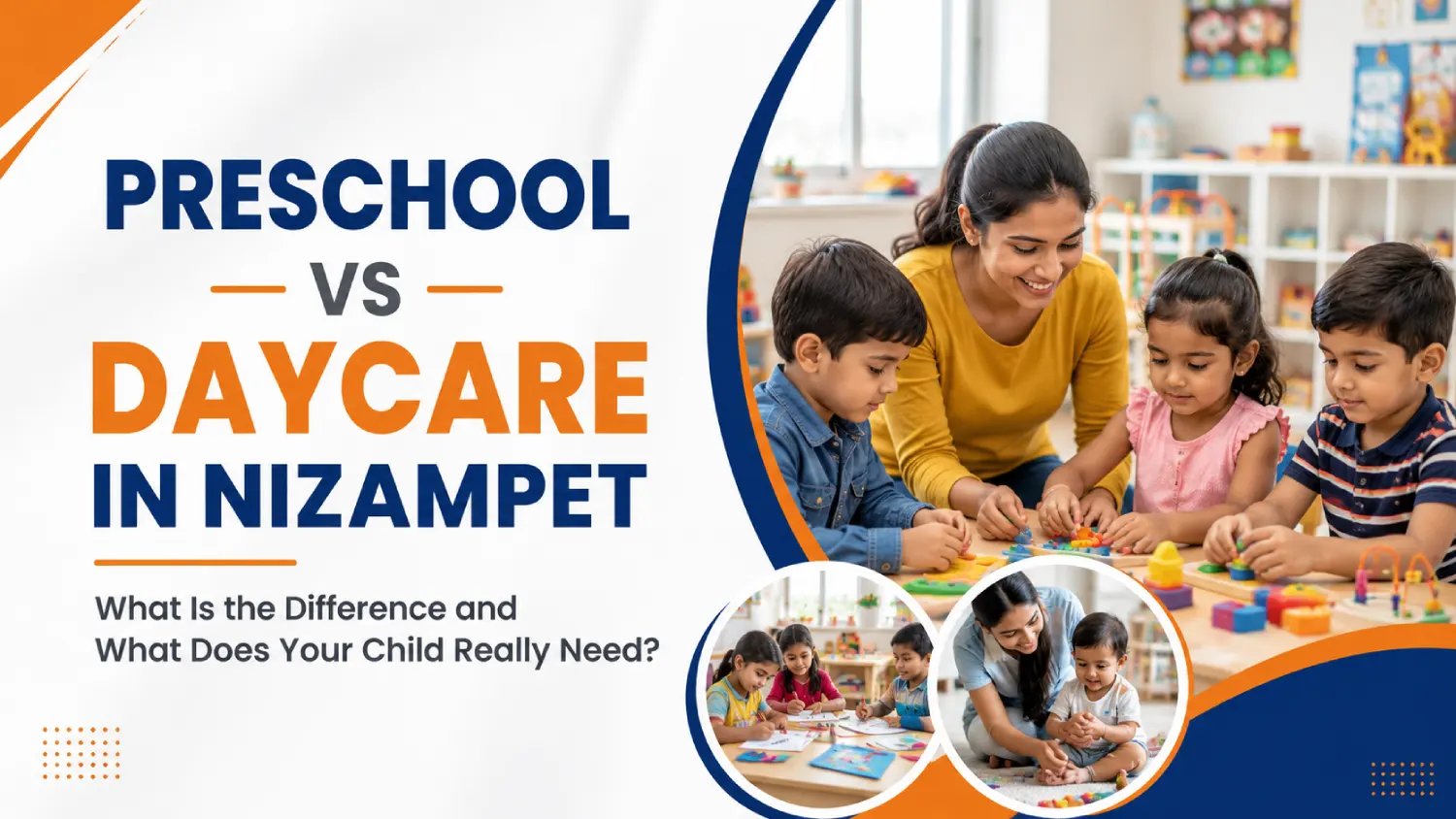
At some point, most parents in Nizampet ask the same question. Should the child join a preschool or a daycare? Both words float around every neighbourhood WhatsApp group. Both promise happy children and busy mornings. They do not mean the same thing. One is built around teaching. The other is built around care. Families who mix up the two often notice the gap only later, usually when the child reaches Class 1. Parents searching for the best pre-primary school in Nizampet deserve a plain answer rather than a brochure. This guide sets out the real difference, the rules behind each option, and what a three-year-old actually needs from the day.
What Is the Real Difference Between a Preschool and a Daycare?
A preschool teaches. A daycare looks after. That one line covers most of it.
A preschool runs a short session with a written plan behind it. A trained teacher decides what happens in every half hour. A daycare runs a long day shaped around meals, naps and safety, and the staff are caregivers first. Both are honest jobs. They simply answer different needs.
It is quite common to hear both services offered under one roof. That works well, provided the school states clearly which hours are teaching hours and which hours are care hours. The best pre-primary school in Nizampet will show a parent that split on paper, not just in conversation.
Table 1: Preschool and daycare side by side
| Point of comparison | Preschool (pre-primary school) | Daycare (creche) |
|---|---|---|
| Main purpose | Planned early learning and school readiness | Safe care and supervision while parents work |
| Usual age band | 2.5 to 6 years | 6 months to 6 years |
| Typical hours | About 2.5 to 4 hours, one fixed session | About 8 to 10 hours, flexible to parent shifts |
| Who guides the child | A trained pre-primary teacher | A trained caregiver or creche worker |
| Written curriculum | Yes, mapped to the Foundational Stage | Not required; activities are age-appropriate |
| Meals and sleep | Usually one snack break | Three meals plus a rest period |
| Governed by | NEP 2020 and NCF for Foundational Stage 2022 | Maternity Benefit (Amendment) Act 2017 and MWCD creche norms |
| Parent gets | Progress notes and learning goals | A day report on food, sleep and mood |
What Do the Rules Say About Each One?
Two different sets of papers govern them, and that explains a great deal.
Preschool sits inside education policy. NEP 2020 grouped children aged 3 to 8 into a new Foundational Stage. NCERT then published the National Curriculum Framework for the Foundational Stage in 2022. It lays down 13 curricular goals across six areas of a child’s growth.
Daycare sits inside labour and welfare law. The Maternity Benefit (Amendment) Act 2017 made a creche compulsory for workplaces with 50 or above employees. The Ministry of Women and Child Development then issued National Minimum Guidelines covering hours, floor space, staffing and child protection.
Not everyone is aware that the private preschool space in India stays largely unregulated. NCERT said so plainly in its own 2022 document. The checking, therefore, falls to parents. Anyone comparing a top pre-primary school in Nizampet with a plain daycare should start with these papers, not with the fee sheet.
Table 2: What the official standards actually fix
| Rule area | Preschool position | Daycare position |
|---|---|---|
| Ages covered | 3 to 6 years, inside a Foundational Stage of 3 to 8 years | 6 months to 6 years |
| Adult to child ratio | No fixed national rule for private preschools | 1 worker and 1 helper per 10 children under 3; per 20 children aged 3 to 6 |
| Floor space per child | No fixed national rule | 10 to 12 square feet |
| Daily hours | Session based, set by the school | 8 to 10 hours, matched to parent shifts |
| Unit size | No fixed national rule | Up to 30 children per creche unit |
| Child protection policy | Good practice, not compelled | Written policy expected, with a police-verified guard |
| Curriculum reference | 13 goals across 6 domains, NCF-FS 2022 | Age-appropriate activities for school readiness |
What Does a Normal Day Look Like in Each Place?
The clock tells the story better than any brochure does.
Table 3: A typical day compared
| Time block | Preschool session | Daycare day |
|---|---|---|
| Arrival | Circle time, rhymes, news of the day | Free play, breakfast, settling in |
| Mid-morning | Phonics, oral language, number games | Snack, indoor games, music |
| Late morning | Outdoor play and motor-skill activity | Outdoor play or open-hall play |
| Midday | Snack, story, goodbye at the gate | Lunch and a supervised nap |
| Afternoon | Session is over | Quiet activity, second snack, free play |
| Evening | Child is at home | Handover to parents, day report shared |
| Length of day | About 3 hours | About 9 hours |
Ask any experienced pre-primary teacher and they will say the same thing. A three-year-old holds attention in short bursts. Stretch that into a six-hour academic day and the child switches off. Stretch a care day into a teaching day without a plan and very little is learnt. The best pre-primary school in Nizampet keeps both blocks separate and honest about what each one does.
Which Option Suits Which Age?
Age settles most of the argument.
Table 4: Age-wise fit
| Child’s age | What the child needs most | Better fit | Why |
|---|---|---|---|
| 6 months to 2 years | Warmth, feeding, sleep, one steady adult | Daycare or creche | Learning goals are not the point yet |
| 2 to 3 years | Company, movement, first words in a group | Play group, half day | Short sessions suit short attention spans |
| 3 to 4 years | Routine, oral language, sharing | Preschool, nursery level | The Foundational Stage begins at 3 |
| 4 to 6 years | Phonics, numbers, pencil control | Preschool, PP-1 and PP-2 | Class 1 readiness is built here |
| 3 to 6, both parents working | Learning first, then safe care | Preschool with daycare added on | One campus, two clearly split blocks |
| Above 6 | Formal school | Class 1 onwards | NEP 2020 sets 6 as the entry age |
A two-year-old needs warmth, food and sleep. A four-year-old needs sounds, stories, friends and a pencil grip. The same building can serve both. The same timetable cannot.
What Do the Numbers Say About Early Learning in India?
Enrolment has climbed year after year, and Telangana sits near the top of the table.
Table 5: Pre-primary enrolment in rural India, 2018 to 2024
| Indicator | 2018 | 2022 | 2024 | Source |
|---|---|---|---|---|
| 3-year-olds in any pre-primary institution | 68.1% | 75.8% | 77.4% | ASER 2024 |
| 4-year-olds in any pre-primary institution | 76.0% | 82.0% | 83.3% | ASER 2024 |
| 5-year-olds in any pre-primary institution | 58.5% | 62.2% | 71.4% | ASER 2024 |
| 5-year-olds in a private school or preschool | 37.3% | 30.8% | 37.5% | ASER 2024 |
| Children in Class 1 who are underage | 25.6% | 22.7% | 16.7% | ASER 2024 |
A closer look at those figures shows something useful. Fewer children now enter Class 1 underage. In 2018, roughly one in four Class 1 children was five or younger. By 2024, that had dropped to about one in six. Parents have stopped rushing children into formal school. They are using the pre-primary school education years for what those years were meant for.
Money has followed the same path. India’s preschool and childcare market stood at about USD 5.59 billion in 2025, and full day care held roughly 64.5 per cent of it. The long day is clearly in demand. The real question is what fills those hours. The best pre-primary school in Nizampet has an answer written down for every one of them.
How Should a Parent in Nizampet Decide?
Start with the child, then the timetable, then the school.
Three questions do most of the work. First, how old is the child? Second, how many hours will the child be away from home? Third, does the place have a written plan for those hours, or only a routine? A daycare answers the second question. A preschool answers the third. The best pre-primary school in Nizampet answers both, without pretending that one is the other.
Table 6: Six questions to ask before you sign the form
| Ask this | Why it matters | A good answer sounds like |
|---|---|---|
| How many children per teacher? | Attention cannot be shared endlessly | A number, said without hesitation |
| May I see the day plan? | A plan on paper means teaching, not minding | A printed weekly sheet, handed over |
| Who is at the gate, and are the cameras live? | Safety is a system, not a promise | A visitor register and a live monitor |
| How do teachers tell me about progress? | Parents should not have to guess | Monthly notes and a fixed meeting slot |
| What happens if my child falls ill? | Small children fall ill often | A named first-aid person and a phone tree |
| May I walk in without notice? | Open doors usually mean nothing to hide | Yes, during working hours |
Why Do Families Around Nizampet Look at MNR Golden Kids?
MNR Golden Kids runs a play-based programme in line with NEP 2020. Lessons sit inside games, stories and activities rather than rote copywriting. The campus is built for small children, with controlled entry, CCTV cover and trained staff. Class sizes are kept small, so a teacher watches every child rather than a crowd. Early literacy and phonics follow a clear plan that builds reading, speaking and early number sense. The campus is within an easy drive for families in and around Nizampet. For parents weighing a top pre-primary school in Nizampet against a nearby creche, that mix is the point. The care is there. The teaching is there too, and it is written down.
Conclusion
Preschool and daycare are not rivals. They are two answers to two different questions. A daycare buys a working family time and keeps the child safe. A preschool builds the habits that decide how Class 1 feels. A child under two needs the first. A child of four needs the second. Many families in Nizampet need both, in that order, on one campus. Parents weighing up the best pre-primary school in Nizampet should ask to see the day plan, count the children per teacher, and walk the corridor once before signing anything. MNR Golden Kids welcomes that visit. Good pre-primary school education starts with a parent who asks questions.
Frequently Asked Questions
A preschool teaches and a daycare looks after. A preschool runs a short session, usually 2.5 to 4 hours, with a written plan tied to the Foundational Stage. A daycare runs 8 to 10 hours built around meals, naps and safety. Many campuses offer both. Parents should ask which hours are which.
Most children join a play group at about 2.5 to 3 years and move to nursery at 3. NEP 2020 begins the Foundational Stage at age 3 and sets Class 1 entry at 6. A daycare can take a child from as young as six months under national creche guidelines.
No. A good daycare keeps a child safe, fed and rested while parents work. The worry is not the daycare itself. It is expecting a daycare to do a teacher’s job. Once the child turns three, look for a teaching plan running alongside the care.
National creche guidelines set one worker and one helper for every 10 children under three, and for every 20 children aged three to six. Private preschools carry no fixed national ratio, so parents should ask for the number and count heads during a visit.
A good one does. The NCERT National Curriculum Framework for the Foundational Stage 2022 sets 13 curricular goals across six areas of growth for ages 3 to 8. Private preschools are not bound to it by law, so parents should ask to see the plan for themselves.
Visit without notice if you can. Look at the day plan, the teacher-to-child ratio, the gate, the toilets and the play area. Watch how a teacher speaks to a crying child. That one moment tells a parent more about pre-primary school education than any brochure will.
Related Blogs
How to Identify Your Child’s Natural Learning Strength
Some children speak loudly about who they are. Others whisper it. And if we are…

The Food, The Feelings, The Future: A Simple Guide to Health & Nutrition for Kids!
There is something deeply moving about watching a child eat with joy. The messy fingers….
Why Rhyming Words Are Taught In the Best Preschool In Hyderabad
At a Top Nursery School in Hyderabad, learning is designed to be joyful, engaging, and…

Deep-Rooted Issues of Pre-Primary Education in India: How the Top Preschool in Sangareddy Makes a Healthy Pre-Primary Learning Environment!
Across India, early childhood education is slowly receiving the attention it deserves. According to national…
Working Parents in Hyderabad: How to Choose the Right Play School
Morning hours in Hyderabad move quickly. Office calls begin early, traffic builds up, and between…
Why Are Parents Across India Choosing CBSE?
These days, many parents talk about one common thing. That is school boards. They think…