
How to Teach Nursery Children at Home Without Worksheets: 10 Everyday Learning Activities
Home / School / How to Teach Nursery Children at Home Without Worksheets: 10 Everyday Learning Activities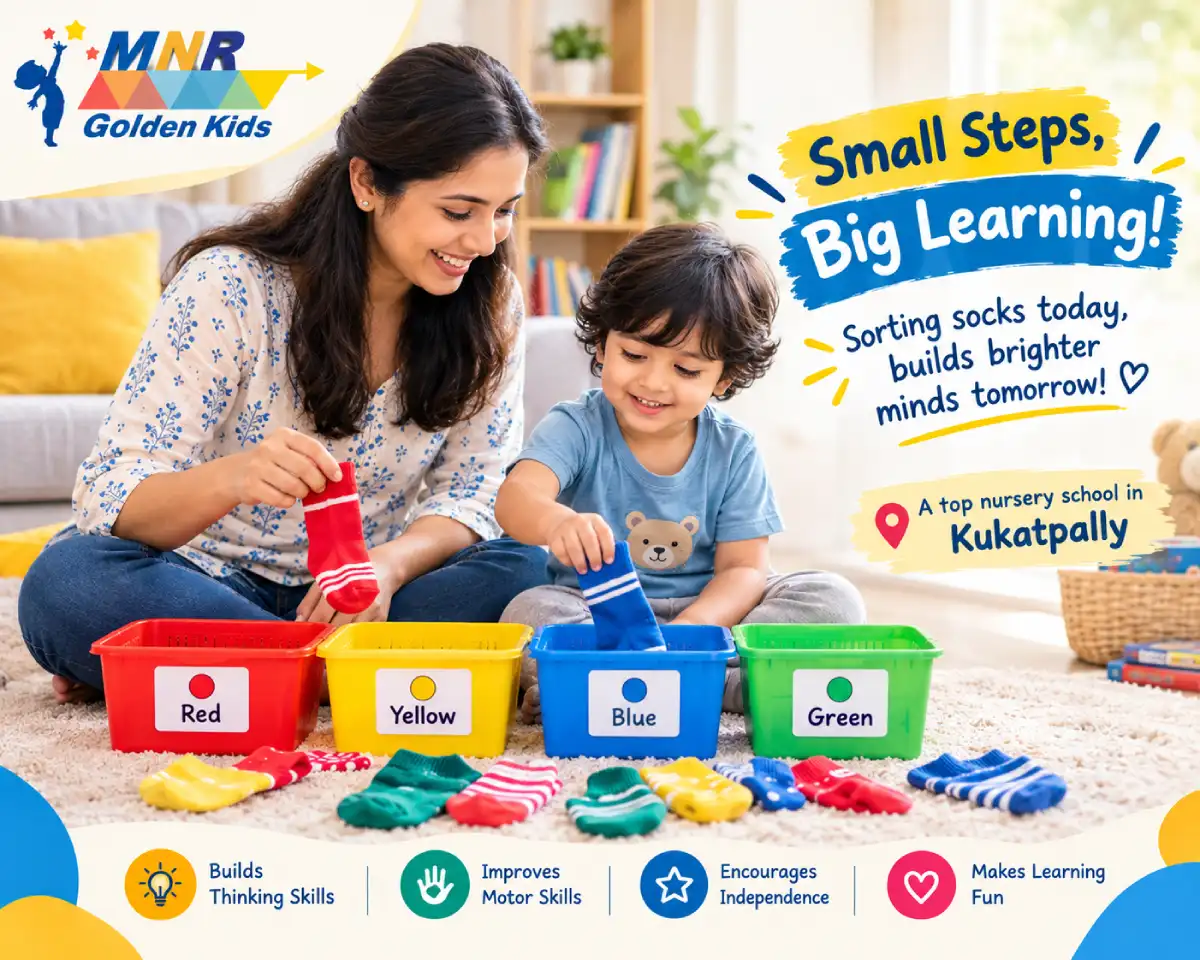
Parents can teach nursery children at home without worksheets by turning daily routines into small games. Sorting laundry, cooking together, telling stories, singing rhymes, pretend play and simple chats build language, maths and thinking skills. Research from Harvard, NEP 2020 and NCERT shows that young children learn best through play and talk. MNR Golden Kids, a top nursery school in Kukatpally, follows the same play-first method in its classrooms across Hyderabad and Mumbai.
Introduction
It is quite common to hear parents ask, “What should my child be learning at home?” Many parents still believe that a pile of worksheets is the answer. Not everyone is aware that a three-year-old often learns far more from a chat in the kitchen than from tracing the letter A ten times.
This guide explains how to teach nursery children at home using things most homes already have. It also shows how MNR Golden Kids, known to many local families as a top nursery school in Kukatpally, works with parents so that school and home pull in the same direction.
Is a Worksheet Needed for Toddlers? What Research Says
The short answer is no. A worksheet now and then does no harm, but it is not how little children learn best.
The NCF-FS 2022 document from NCERT says children aged 3 to 6 should have no prescribed textbooks. It names play as the main way they learn. NEP 2020 notes that over 85% of a child’s brain development happens before the age of six. That is a short window, and much of it happens at home.
To a large extent, young children learn by touching, moving, asking and repeating. So, is worksheet needed for toddlers? Not really. Play, talk and real tasks do the job better.
What Is Play-Based Learning?
Play-based learning means children pick up skills through games, talk and real tasks rather than written drills. A child counting spoons at lunch is doing maths. A child acting out a shopkeeper is building language. Both learn without worksheets.
Table 1: What Research Says About Early Learning at Home
| Finding | What It Means for Parents | Source |
|---|---|---|
| Over 1 million new neural connections form every second in the first few years of life | Daily talk and play help build the brain | Harvard Center on the Developing Child |
| Over 85% of brain development happens before age 6 | The home years matter a great deal | NEP 2020, Ministry of Education, India |
| No prescribed textbooks for ages 3 to 6; play is the main method | Worksheets are optional, not the main tool | NCF-FS 2022, NCERT |
| Five picture books a day means about 1.4 million extra words heard by age 5 | Reading aloud grows vocabulary fast | Ohio State University (2019) |
| One book a day means about 290,000 extra words by age 5 | Even one story a day helps | Ohio State University (2019) |
| Back-and-forth chats are linked to stronger language areas in the brain | Talk with a child, not at a child | MIT McGovern Institute (2018) |
| Children aged 2 to 4 should have under 1 hour of screen time a day | Swap screen time for play | World Health Organization (2019) |
Worksheets vs Everyday Activities: A Quick Comparison
Table 2: Worksheets vs Everyday Activities for Nursery Children
| Area | Worksheets | Everyday Activities |
|---|---|---|
| Senses used | Mostly eyes and fingers | Touch, sight, sound, smell and movement |
| Language | Very little talk | Lots of talk and questions |
| Maths ideas | Counting printed pictures | Counting real spoons, steps and rotis |
| Attention | Short, often ends in tears | Longer, because the child is having fun |
| Parent’s role | Checks answers | Plays alongside |
| Cost | Printing and workbooks | Free, uses household items |
10 Everyday Learning Activities for Nursery Children at Home
These practical activities need no special kit. Parents can pick two or three a day, about 10 to 15 minutes each.
1. Sorting the Laundry
Laundry day is a hidden maths lesson. Ask the child to put socks in one pile and shirts in another. Then sort by colour and find pairs. This builds sorting, matching and early counting. “Can you find Papa’s blue sock?” is a full lesson in colour, size and family words.
2. Kitchen Counting and Measuring
The kitchen is full of numbers. A child can count five potatoes, pour one cup of rice or line up spoons from big to small. “We need two onions. How many do we have now?” Numbers stick faster when they mean something, like dinner.
3. Story-Telling at Bedtime
Story-telling is one of the oldest teaching tools. Read a picture book or tell a family story. Stop now and then and ask, “What do you think happens next?” Ohio State researchers found that even one book a day adds about 290,000 words by age five.
Let the Child Become the Storyteller
Once a week, swap roles. Let the child tell the story from the pictures. The aim is confidence, not perfect grammar. Teachers at a top nursery school in Kukatpally like MNR Golden Kids use this same “Show and Tell” habit in class.
4. Rhymes and Action Songs
Rhymes teach sounds, rhythm and memory together. “Twinkle Twinkle”, a Hindi rhyme or a Telugu lullaby all count. Add claps and stamps. Rhyming games also help children hear the small sounds inside words, which helps with reading later.
5. Pretend Play with Household Items
Pretend play turns a dupatta into a superhero cape and a steel plate into a steering wheel. Set up a pretend shop with real fruit and paper money. This builds language, turn-taking and problem-solving. NCERT lists dramatic play as a main type of play for this age.
6. Everyday Conversation on the Go
Everyday conversation may be the easiest activity of all. Ask open questions on the walk to the park like, “Why do you think that dog is barking?” Then wait for the answer. MIT researchers found that back-and-forth chats matter a lot for language growth.
7. Nature Walks and Treasure Hunts
A short walk around the colony can become a treasure hunt. Ask the child to find three leaves, one round stone and something yellow. This mixes counting, colours, shapes and outdoor play in one go.
8. Water and Sand Play
A bucket of water, some cups and a funnel can keep a child busy for ages. Which cup holds the most? Which toy floats? These are early science ideas like full, empty, heavy and light. Lay down an old towel. Mess is often where the learning hides.
9. Art with Scraps
Old newspapers, bottle caps, buttons and leftover wool make great art supplies. Tearing paper and picking up buttons build the small hand muscles needed for holding a pencil. So the child gets ready to write without a single worksheet.
10. Helping with Simple Chores
Watering plants, setting the table or putting toys back in a box are real learning tasks. Setting four plates for four people is one-to-one counting. A child who hears “Thank you, you were a big help” also learns that effort matters.
Table 3: The 10 Activities at a Glance
| Activity | Household Items | Main Skill Built | Time |
|---|---|---|---|
| Laundry sorting | Clothes and socks | Sorting, colours, matching | 10 min |
| Kitchen counting | Vegetables, spoons, cups | Numbers, size | 10 min |
| Story-telling | Picture books, family stories | Vocabulary, listening | 15 min |
| Rhymes and songs | Nothing at all | Sounds, memory | 5 to 10 min |
| Pretend play | Dupatta, plates, toys | Language, social skills | 15 min |
| Everyday conversation | None | Speaking, thinking | Any time |
| Nature treasure hunt | A bag or box | Counting, shapes, fitness | 20 min |
| Water and sand play | Cups, funnel, bucket | Early science | 15 min |
| Scrap art | Paper, buttons, glue | Hand control | 15 min |
| Simple chores | Plates, plants, toy box | Counting, responsibility | 10 min |
How Parents Can Support Learning Without Turning Home into a Classroom
Home should feel safe and relaxed. In practical terms, these small habits help the most:
- Follow the child’s interest. If they love trucks, count trucks.
- Keep it short. Ten happy minutes beat forty tired ones.
- Praise effort, not only right answers.
- Say yes to play. The American Academy of Pediatrics even asks doctors to write a “prescription for play”.
- Keep screens low. WHO advises under one hour a day for children aged 2 to 4, and less is better.
- Ask the class teacher what topic the child is learning that week, then talk about it at home.
Signs a Child Is Learning Well at Home
- Asks lots of “why” questions
- Uses new words picked up from stories
- Counts things during play without being asked
- Plays pretend games for longer stretches
It is worth noting that every child grows at their own pace.
Table 4: WHO Daily Guide for Children Aged 3 to 4
| Area | WHO Advice | Easy Home Idea |
|---|---|---|
| Physical activity | At least 180 minutes, including 60 minutes of energetic play | Treasure hunts, dancing to rhymes |
| Screen time | Under 1 hour, and less is better | Swap one cartoon for one story |
| Sitting still | Avoid long spells of being strapped in or seated (over 1 hour at a time) | Short movement breaks |
| Sleep | 10 to 13 hours of good sleep, naps included | A fixed bedtime story routine |
How MNR Golden Kids, a Top Nursery School in Kukatpally, Teaches with Care
MNR Golden Kids follows the same play-first idea.
Classes run for Play Group, PP-1 and PP-2. Teachers use story-telling, rhyming games, Show and Tell and puppet play to build speaking skills. Teachers check each child’s growth every month and share it with parents. This is one reason many local parents count it among the best schools for toddlers in Kukatpally.
Safety comes first. Classrooms and play areas are kept clean and hygienic. Staff go through safeguarding training every two years. The aim is simple: a child should feel at home from day one. Families looking for a top nursery school in Kukatpally often say this caring touch matters as much as the lessons.
Read More: How to Choose the Right Playschool for Your Child
Why Choose MNR Golden Kids
Table 5: MNR Golden Kids USPs and What They Mean for a Child
| USP | What It Means for a Child |
|---|---|
| International standards in early education | Learning goals planned with global good practice in mind |
| Teachers trained through UK-based training (London School of Training) | Skilled, caring teachers who know how small children learn |
| Experiential and play-based learning | Learning by doing, not by rote |
| Individual attention and monthly monitoring | Each child’s progress is tracked and shared |
| Safe, hygienic and secure campus | Peace of mind for parents |
| Strong focus on communication skills | Confident little speakers |
| Creative and co-curricular activities | Chess, arts and crafts, dance, yoga, sports and self-defence |
| Age-appropriate learning spaces | Rooms built for small hands and short attention spans |
| Established MNR legacy since 1974 | Over five decades in education, from KG to PG |
| Multiple locations | Branches in Hyderabad and Mumbai |
Wider MNR campus facilities include smart boards, a language lab, a resource centre, physics and chemistry labs and guest lectures. Parents comparing the best schools for toddlers in Kukatpally can read about the MNR legacy or check the admission process for 2026-27.
Conclusion
Teaching a nursery child at home does not need worksheets, apps or a timetable. It needs a grown-up who talks, listens, sings and plays. When home and school follow the same play-first approach, children grow in confidence. For families who want that approach in the classroom too, MNR Golden Kids remains a strong choice as a top nursery school in Kukatpally, with the same care offered across its Hyderabad and Mumbai branches.
Follow Us: Facebook
Frequently Asked Questions
Use daily routines. Sorting laundry, kitchen counting, stories, rhymes and pretend play teach language and maths without printed sheets.
No. NCERT's NCF-FS 2022 says children aged 3 to 6 learn best through play. An odd worksheet is fine, but not as the main tool.
Laundry sorting, kitchen counting, story-telling, rhymes, pretend play, nature walks, water play, scrap art and chores. All use common household items.
Two or three activities of 10 to 15 minutes each are plenty. Daily chats add the rest.
It builds vocabulary, listening and imagination. One book a day adds about 290,000 words by age five, says Ohio State University.
Back-and-forth chats build speaking and thinking. MIT researchers linked them to stronger activity in the brain's language areas.
WHO advises under one hour a day for children aged 2 to 4, and less is better.
MNR Golden Kids, opposite JNTU, is a popular choice for its play-based learning, UK-trained teachers and monthly progress checks.
Play Group, PP-1 and PP-2, covering language, numbers, art, dance and values through play.
Yes. It has branches across Navi Mumbai, such as Kamothe and Karanjade, and play schools in Dubai.
Related Blogs
Why Nursery Children Learn at Different Speeds: How Parents Can Support Individual Progress
Nursery children learn at different speeds because each child’s brain grows on its own timetable….
How to Choose the Best Preschool in Navi Mumbai for Your Child
The first day a child walks into a preschool stays in a parent’s memory for…

The Gentle Strength of Daily Routine: How Simple Habits Help Young Minds Grow Strong
There is a quiet joy in watching a child follow a daily pattern with confidence….
How to Choose the Right Playschool for Your Child: A Parent’s Complete Guide
Overview Parents looking for a nursery school in Sangareddy should check five things before enrolling:…

Why Play-Based Learning Is More Powerful Than Worksheets
There is something quietly powerful about watching a four-year-old play with blocks and build a…

Why Some Preschool Children Refuse to Eat at School: Practical Tips for Parents and Teachers
Why Do Some Preschool Children Refuse to Eat at School? Some preschool children refuse to…