
Fine Motor Skills Before Writing: Activities That Prepare Nursery Children for Pencil Control
Home / School / Fine Motor Skills Before Writing: Activities That Prepare Nursery Children for Pencil Control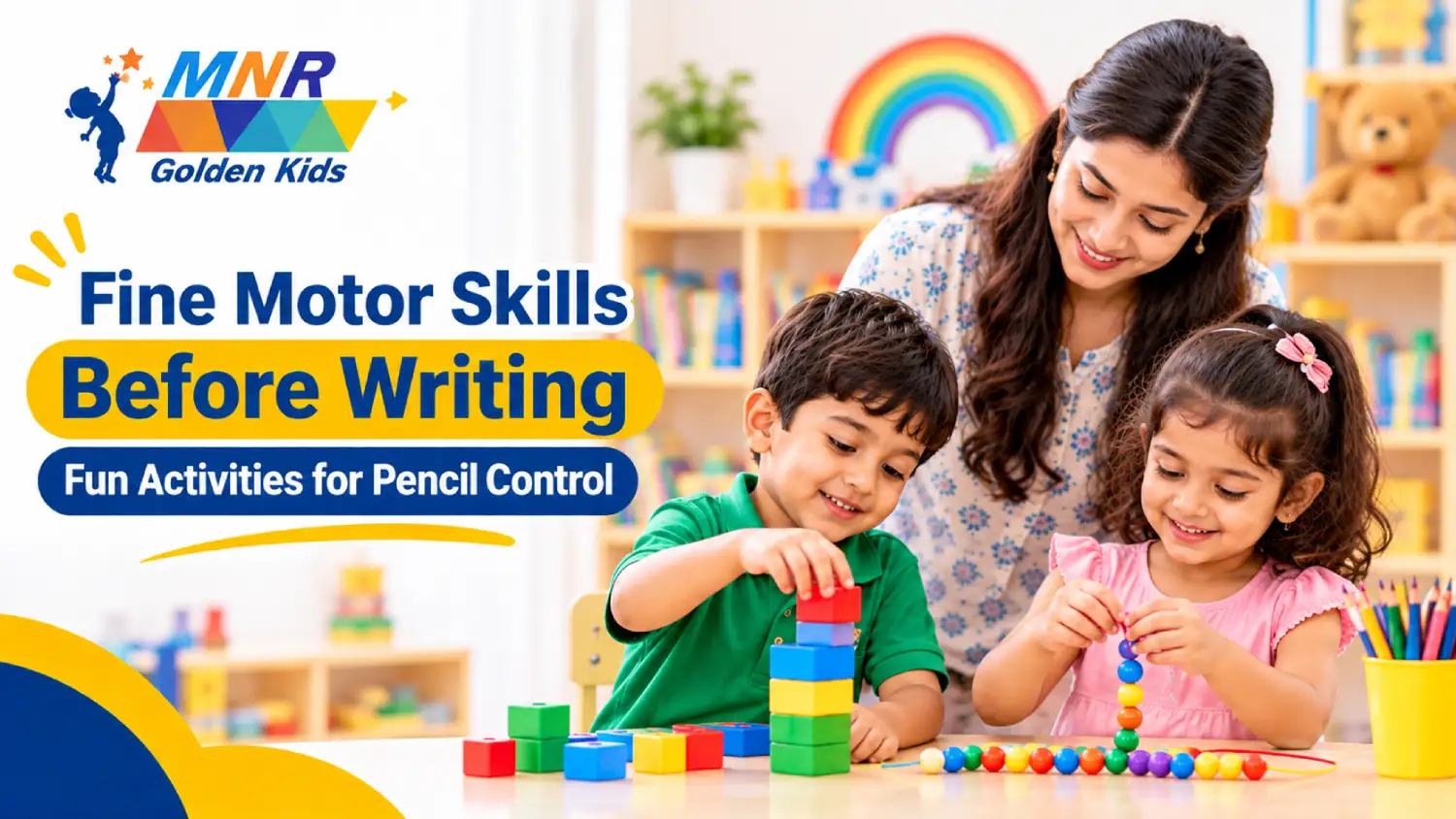
What Should Parents Know About Fine Motor Skills Before Writing?
Fine motor skills are the small, careful movements of the fingers, hands and wrists. A nursery child needs them before a pencil feels easy to hold. Play builds them best. Squeezing playdough, threading beads, tearing paper, using clothes pegs and painting on an easel all make little fingers stronger and steadier. Most children move to a three-finger (tripod) pencil grip between 4 and 6 years of age. At MNR Golden Kids, a top preschool in Sangareddy on the MNR Medical Campus, these skills grow through arts and crafts, music, movement and daily classroom play.
Why Do Hands Need to Get Ready Before a Child Writes?
It is quite common to hear parents say, “My child is four. Why can’t she write her name yet?” The honest answer often has little to do with letters. It has a lot to do with hands.
Writing asks a lot from a small body. The shoulder must stay steady. The wrist must bend just right. Three tiny fingers must hold a pencil and move it in a small space. If these muscles are still weak, the child presses too hard, gets tired fast and starts to dislike writing.
Not everyone is aware that hand readiness comes before pencil work. So parents comparing the top preschool in Sangareddy with other options should look at how a school builds hand strength. How early it hands out worksheets matters far less.
What Are Fine Motor Skills in Nursery Children?
Fine motor skills are small movements made by the muscles in the hands and fingers. They work as a team with the eyes. Experts call this eye-hand coordination.
For a nursery child, these skills show up everywhere. Buttoning a shirt, opening a tiffin box, turning book pages and picking up a single grain of rice all use them.
Which Fine Motor Milestones Should Parents Expect From Age 3 to 5?
Every child grows at their own pace. Still, health bodies give a rough guide. The table below compares two well-known sources side by side.
Table 1: Fine Motor Milestones by Age (CDC vs AAP)
| Age | CDC (Learn the Signs. Act Early.) | American Academy of Pediatrics (HealthyChildren.org) |
|---|---|---|
| 3 years | Threads large beads onto a string; uses a fork; draws a circle when shown how | Copies a circle; traces a square; holds a crayon with the thumb on one side and fingers on the other |
| 4 years | Holds a crayon or pencil between fingers and thumb, not in a fist; unbuttons some buttons | Holds the paper with one hand while drawing with the other (AAP groups ages 4 and 5) |
| 5 years | Buttons some buttons; writes some letters of their name | Cuts with safety scissors, pastes, paints with a brush and models clay (ages 4 to 5) |
Sources: CDC Milestone Checklists (3, 4 and 5 years); American Academy of Pediatrics, HealthyChildren.org
How Does Pencil Control for Nursery Children Develop Step by Step?
Pencil control for nursery children grows in stages. A toddler grabs a crayon in a fist. By the early school years, most children hold it with their fingertips. The grip changes because the hand gets stronger. Nobody can rush it by forcing a “correct” hold too early.
Table 2: Pencil Grip Stages by Age (NHS Wales)
| Approx. Age | Grip Name | What It Looks Like | What the Child Can Draw |
|---|---|---|---|
| 1 to 2 years | Fisted (palmar) grip | Crayon held like a dagger; the whole arm moves | Scribbles |
| 2 to 3 years | Digital pronate grip | All fingers on the crayon, palm facing down; movement comes from the elbow | Copies straight lines and circles |
| 3 to 4 years | Four-finger (quadrupod) grip | The hand moves as one unit from the wrist | Zig-zags, crosses, simple dot-to-dots and simple people |
| 4 to 6 years | Static tripod grip | Thumb, index and middle finger hold the pencil | Diagonal lines, squares, circles and triangles |
| 6 to 7 years | Mature tripod grip | Ring and little fingers tuck in; fingertips move the pencil | Neat letters with less effort |
Source: Children’s Occupational Therapy Service, Aneurin Bevan University Health Board (NHS Wales)
Why Does the Tripod Grip Matter So Much?
The tripod grip lets the fingertips do the small work while the arm stays relaxed. So the child can write for longer without aching hands. Ask any experienced nursery teacher, and they will tell you the same thing. A child who skips the hand-strength stage often squeezes the pencil far too tightly later.
Why Do Parents Look for the Top Preschool in Sangareddy for Early Writing Readiness?
Families in Sangareddy, Patancheru and along Narsapur Road want what city parents want. They want a school that gets the basics right. The top preschool in Sangareddy should treat hand skills as part of the daily plan, not as an extra.
Research backs this up. A 2010 study in Developmental Psychology by David Grissmer and colleagues studied six large data sets. It found that fine motor skills at school entry were a strong predictor of later success in reading, maths and science. India’s National Education Policy 2020 also notes that over 85% of a child’s brain development happens before the age of 6.
The demand on little hands starts early too. A 2020 classroom study in the American Journal of Occupational Therapy tracked how much of the school day needs fine motor work.
Table 3: Share of the School Day Spent on Fine Motor Tasks
| Class | Fine Motor Tasks (% of School Day) | Paper-and-Pencil Share of Fine Motor Time | Handling Objects Share of Fine Motor Time |
|---|---|---|---|
| Kindergarten | 37.1% | 17.8% | 82.2% |
| Grade 2 | 50.1% | 35.8% | 64.2% |
| Grade 4 | 60.2% | 37.4% | 62.6% |
Source: Caramia, Gill, Ohl & Schelly (2020), American Journal of Occupational Therapy, 74(2)
This is where things become interesting. In kindergarten, most fine motor time goes into handling objects, not pencils. Cutting, sticking, opening, building and sorting come first. Writing follows.
Table 4: Key Early Years Data at a Glance
| Fact | Figure | Source |
|---|---|---|
| Brain development completed before age 6 | Over 85% | National Education Policy 2020, Ministry of Education, India |
| Age most children reach a mature pencil grip | 6 to 7 years | NHS Wales Children’s OT Service |
| Age a child should hold a crayon with fingers, not a fist | By 4 years | CDC Milestone Checklist |
| Fine motor skills as a predictor of later achievement | Strong predictor across six data sets | Grissmer et al. (2010), Developmental Psychology |
Sources: Ministry of Education (India), NHS Wales, CDC, Developmental Psychology
What Should Parents Check When Visiting a Preschool?
Does the Top Preschool in Sangareddy Put Play Before Worksheets?
A good sign is a classroom full of playdough, blocks, beads, chalk and paint. A warning sign is a three-year-old with a big pile of tracing sheets. Parents can ask a few simple questions. How often do children cut and paste? Do they paint standing up? Does the teacher watch the grip and gently guide it?
Read More: Why Nursery Children Learn at Different Speeds: How Parents Can Support Individual Progress
Which Fine Motor Activities for Nursery Children Build Pencil Control?
The best fine motor activities for nursery children feel like play. Children have no idea they are training their hands. They just know it is fun.
What Simple Activities Work Every Day?
Table 5: Fine Motor Activities and the Skills They Build
| Activity | Skill It Builds | Easy Home Version |
|---|---|---|
| Squeezing and rolling playdough | Hand strength | Roll “snakes” and pinch tiny balls |
| Threading beads or pasta | Pincer grip and eye-hand coordination | String macaroni on a shoelace |
| Clothes pegs | Finger pinch strength | Clip pegs around a paper plate |
| Tearing paper | Two hands working together | Tear old newspaper for a collage |
| Painting on an easel or wall | Wrist stability | Tape paper to a wall and paint with a brush |
| Spray bottle play | Grip strength | Water the plants with a trigger spray |
| Finger rhymes | Moving each finger on its own | Sing “Where Is Thumbkin?” |
| Safety scissors | Controlled opening and closing of the hand | Snip strips of coloured paper |
Sources: NHS Wales Children’s OT Service; American Academy of Pediatrics, HealthyChildren.org
Why Does Drawing on a Wall or Easel Help?
When a child draws on an upright surface, the wrist bends back on its own. That is the same position needed for neat writing. It also builds shoulder strength, which keeps the arm steady at a desk later.
How Can Parents Help at Home Without Worksheets?
Parents do not need fancy kits. The kitchen and the balcony are full of good tools. For more ideas, read our guide on how to teach nursery children at home without worksheets.
- Let children help in the kitchen by tearing coriander, peeling a boiled egg or kneading roti dough.
- Give them small tongs to pick up peas, pom-poms or paper balls.
- Offer broken crayons. Short crayons nudge the fingers into a better grip without any fuss.
- Keep screen time low. Tapping a screen does little for finger strength.
- Praise the effort, not the neatness.
Read More: How to Teach Nursery Children at Home Without Worksheets: 10 Everyday Learning Activities
How Does MNR Golden Kids Build Pencil Control in Nursery Children?
At MNR Golden Kids, hand skills are part of the whole day. Arts and crafts time means cutting, sticking, colouring and clay. Dance and yoga build the shoulder and core strength that a steady hand needs. Chess asks small fingers to lift and place pieces with care. The MNR Golden Kids Sangareddy branch describes its approach as activity-based learning that develops the coordination of “head, heart and hand”.
Teachers check each child’s progress every month. If a child still holds the crayon in a fist, the teacher spots it early and offers more hand play to build strength. Children also chat, sing and tell stories through the day, which ties in with building speaking skills in preschool children.
What Makes MNR Golden Kids Stand Apart?
- International standards in early education, backed by the MNR educational legacy that began with a small school in Hyderabad in 1974.
- Teachers trained through UK-based training with the London School of Training, UK.
- Experienced and qualified teachers who give every child close attention and check progress every month.
- Play-based, experiential learning in age-appropriate learning spaces.
- A safe and secure setting with child-safe furniture, non-toxic toys and child ID cards.
- A caring, supportive atmosphere with a strong focus on communication skills.
- Creative and co-curricular activities such as arts and crafts, dance training, chess, yoga, self-defence, sports and games, and guest lectures.
- Top-class infrastructure across the MNR network, including smart boards, a language lab, a resource centre, and physics and chemistry labs for older students.
- Multiple locations in Sangareddy, Hyderabad and Mumbai. Families comparing the top preschool in Hyderabad will also find branches in Chanda Nagar, Bhagyanagar and Gudimalkapur. See all MNR Golden Kids branches in Hyderabad.
When Should Parents Worry About Fine Motor Delays?
For the most part, small delays are normal. Still, it is worth talking to the class teacher or a paediatrician if a child:
- Still uses a fist grip well after the age of 4.
- Cannot thread large beads by around 3 to 4 years.
- Avoids drawing, colouring or puzzles completely.
- Gets very tired or upset during simple hand tasks.
A paediatric occupational therapist can help. Early support usually works well, and children catch up faster when help starts young.
Do Strong Hands Lead to Good Handwriting?
Yes, they do. Pencil control does not start with the pencil. It starts with playdough, pegs, beads and paint. Children who get plenty of hand play in nursery tend to write later with less stress and more joy. For families in and around Sangareddy, MNR Golden Kids is a top preschool in Sangareddy that mixes play, art and movement, so writing feels natural when the time comes. A short visit to the MNR Medical Campus branch is the easiest way to see it in action. Parents can apply for admission 2026-27 online or contact the school directly.
Follow Us: Facebook
Frequently Asked Questions
Fine motor skills are small movements of the hands and fingers, guided by the eyes. Preschool children use them to hold crayons, button clothes, use scissors and pick up small objects.
Most children use a static tripod grip between 4 and 6 years. A mature, relaxed grip usually settles by 6 to 7 years, according to the NHS Wales Children's OT Service.
Playdough, threading beads, clothes pegs, tearing paper, easel painting, finger rhymes and safety scissors all work well. They build strength and control through play.
A few worksheets are fine after age 4. Play should come first, though. Worksheets do little for a child whose fingers are not yet strong enough.
Use kitchen tasks, tongs, pegs and broken crayons. Let children draw on a wall-mounted sheet. Keep sessions short and fun, and praise effort.
A fist grip is normal for toddlers. If it continues well after age 4, the hand muscles may need more strength. Extra play with dough, pegs and beads often helps.
MNR Golden Kids (G-15) on the MNR Medical Campus, Narsapur Road, Faslawadi, Sangareddy, is a popular choice. It offers play-based learning, UK-trained teachers and a safe campus.
The Sangareddy branch offers Playgroup, Nursery, LKG and UKG. Children finishing UKG may move to Grade 1 at the MNR main school, subject to conditions.
Yes. Branches run in Chanda Nagar (BHEL), Bhagyanagar near JNTU and Gudimalkapur in Mehdipatnam, along with branches in Mumbai.
Teachers monitor each child's growth every month. This helps them spot grip, speech or social needs early and plan the right support.
Not much. Tapping and swiping use very little finger strength. Real objects like clay, beads and crayons do a far better job.
Related Blogs

Best Preschools in Mumbai (2027-28): How to Choose the Right One
The best preschool for your child is close to home. It is play-based. It has…
Why Are Parents Across India Choosing CBSE?
These days, many parents talk about one common thing. That is school boards. They think…
Preschool in Navi Mumbai (2027-28): How to Find the Best One, Node by Node
Start with preschools and play schools in your own node. Then pick the ones that…

Best Pre-Primary School in Kamothe for Your Child’s Bright Future
Choosing your child’s first school is one of the biggest decisions for any parent. The…

Best Preschools in Panvel (2027-28): An Area Guide for New Panvel, Old Panvel, Karanjade and Kon
The best preschool for your child is in your own area. It is play-based and…

How Do Parents Find the Best Pre-Primary School in New Panvel for 2025-26?
Choosing a preschool is one of the first big decisions a parent makes for their…